Research Question
How do realised returns differ between freehold and leasehold properties, and across remaining-lease bands? For 99-year leasehold housing, I also examined how observed prices compare with the theoretical lease-decay curve commonly known as Bala’s Curve.
May 2026 data and method
The May paper uses URA REALIS transactions through April 2026 and 155,301 non-EC completed buy-sell pairs: 66,771 freehold and 88,530 leasehold. Very long 999-year leases are grouped economically with freehold, rather than treated as ordinary 99-year leasehold. I used a repeat-sales methodology. I compared returns by tenure and remaining lease, and constructed an empirical lease-decay curve from transaction price-per-square-foot (PSF) data.
The analysis included:
- a 2x2 entry-type-by-tenure decomposition of returns
- district-level comparisons of the freehold premium
- realised performance across remaining-lease bands
- the supply conditions underlying the freehold premium
The supply analysis highlighted that government land sales have not released freehold residential sites for some time. New freehold supply therefore now comes primarily from the en-bloc redevelopment of existing freehold land.
Findings
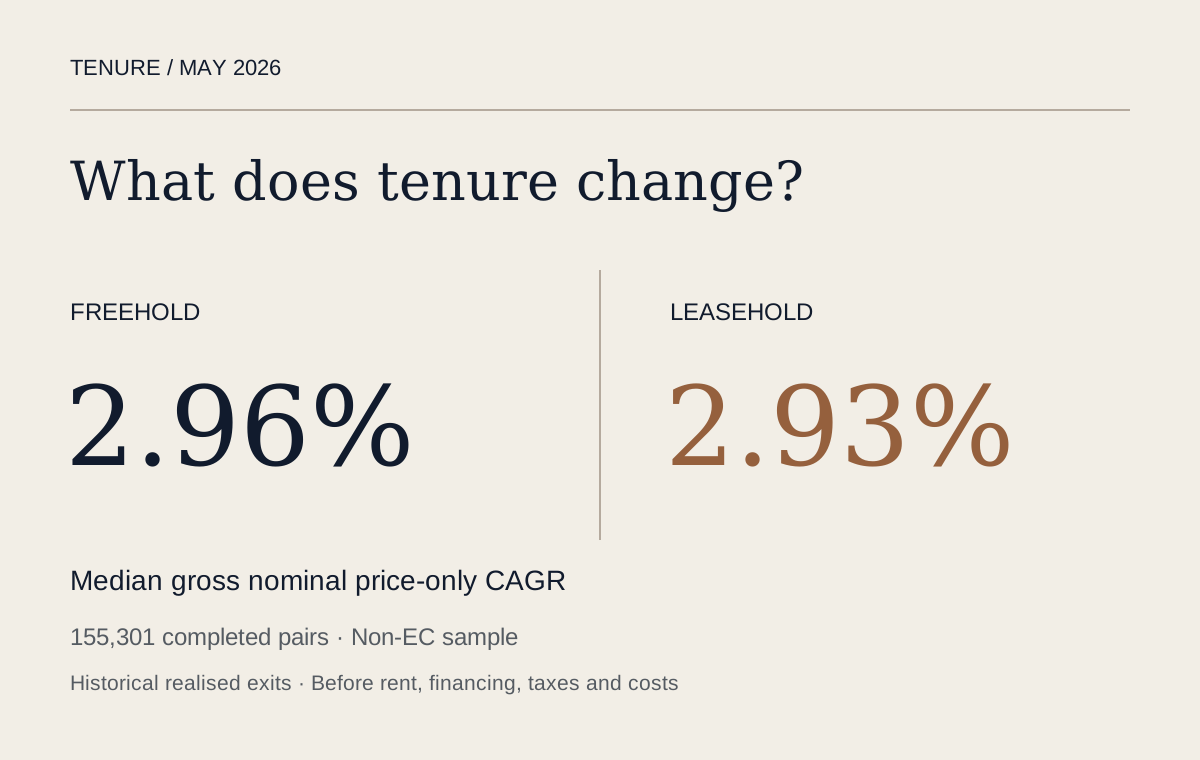
Median annualised returns were similar overall:
- Freehold: 2.96%
- Leasehold: 2.93%
For properties purchased with at least 70 but fewer than 80 years of remaining lease, the reported 4.89% median annualised return applies only to completed exits with at least 60 years of lease remaining at sale. In that viable-exit subset, the nominal loss rate was 11.5%. This condition is part of the result; it is not a return for every purchase in the entry-lease band. The 60-year exit condition defines the study’s sample; it is not a universal financing eligibility rule or a guarantee of marketability.
The empirical PSF curve lay below Bala’s theoretical benchmark around 70-75 years of remaining lease. This is a descriptive benchmark comparison. The prices are not quality-adjusted matched valuations, so the gap does not establish mispricing, an optimal lease length to buy, or a causal effect of lease decay.
Separate June 2026 EC-excluded sensitivity
A later extraction and matching exercise, through 9 June 2026, contains 147,385 non-EC pairs: 62,580 freehold and 84,805 leasehold. Its median gross nominal price-only CAGRs are 2.8254% for freehold and 2.8866% for leasehold.
Within June’s 70-80-year entry band, 4,793 of 5,231 pairs (91.63%) have at least 60 years remaining at exit. This viable-exit subset has a 4.9013% median CAGR and an 11.5% nominal loss rate.
These June checks corroborate the broad descriptive pattern; they are not an exact replication of May. Differences in extraction, matching and cleaning mean the sample change cannot be explained by the cutoff or EC exclusion alone. The May paper’s 155,301 pairs and 2.96%/2.93% figures remain its own version.
The June new-launch/resale study has an EC-inclusive headline of 166,970 pairs. Its aggregate tenure medians are 2.8254% freehold and 3.1974% leasehold. The higher leasehold median in that population includes ECs; it should not be substituted for the non-EC comparison above.
Interpretation
The aggregate freehold-leasehold comparison conceals differences within the lease cycle. These are historical findings for the segments studied, rather than recommendations about an individual property or project.
The return metric measures gross nominal transaction-price growth. It excludes rent, financing, taxes, transaction and ownership costs, inflation and unsold holdings. These descriptive realised-exit findings are neither causal estimates nor investment recommendations.